



Introduction
Choosing the right college is one of the most important decisions in a student’s academic journey. While selecting a course and career path is crucial, choosing between a government college and a private college can significantly influence your learning experience, career opportunities, and overall personal development.
Many students assume that government colleges are always the better option because of their affordability and reputation, while others believe private colleges offer superior infrastructure and industry exposure. In reality, both have their own strengths, and the right choice depends on your academic goals, financial situation, preferred learning environment, and career aspirations.
Understanding the differences between government and private colleges can help students and parents make an informed decision instead of relying on common misconceptions.
Understanding Government Colleges
Government colleges are institutions established and funded by the central or state government. These colleges generally offer education at a subsidized fee and admit students primarily through entrance examinations and merit-based counseling.
Many government colleges have built strong academic reputations over several decades and are known for experienced faculty, research opportunities, and competitive student communities.
Admission to these institutions is often highly competitive because of limited seats and lower tuition costs.
Understanding Private Colleges
Private colleges are owned and managed by private educational organizations or trusts. These institutions offer undergraduate and postgraduate programs across various disciplines and often focus on providing modern infrastructure, industry-oriented education, and updated learning resources.
Many private colleges also offer admissions through entrance examinations, merit-based selection, and management quota depending on the institution’s admission policies.
Over the past decade, several private universities and colleges have developed excellent academic standards, global collaborations, and strong placement records.
Academic Quality
Academic quality depends more on the individual institution than its ownership.
Several government colleges have an excellent reputation for academic excellence, highly qualified faculty, and research-oriented education. Their rigorous admission process often results in a highly competitive learning environment.
At the same time, many leading private colleges have invested heavily in experienced faculty members, advanced laboratories, international collaborations, modern teaching methods, and industry-focused curricula.
Students should evaluate the academic performance of individual colleges rather than assuming one category is always superior.
Admission Process
Government colleges generally admit students based on entrance examination scores, merit rankings, and centralized counseling conducted by universities or government authorities.
Competition for admission is usually intense due to the limited number of seats and affordable tuition fees.
Private colleges often provide multiple admission pathways, including entrance examinations, merit-based admissions, and management quota seats where applicable. This gives students greater flexibility in securing admission to their preferred course.
Students who narrowly miss government college cutoffs often find excellent opportunities in reputed private institutions.
Fee Structure
One of the most noticeable differences between government and private colleges is the cost of education.
Government colleges receive financial support from the government, allowing them to offer significantly lower tuition fees. This makes them an attractive choice for students seeking affordable higher education.
Private colleges generally have higher tuition fees because they independently fund infrastructure development, technology, faculty recruitment, research facilities, and student services.
However, many private institutions also provide scholarships, financial assistance, education loans, and merit-based fee concessions to deserving students.
Students should evaluate the overall value offered by a college rather than focusing only on tuition fees.
Infrastructure and Campus Facilities
Private colleges often have an advantage when it comes to campus infrastructure.
Many private institutions regularly invest in modern classrooms, digital learning platforms, advanced laboratories, innovation centers, libraries, sports complexes, hostels, and recreational facilities.
Government colleges may have excellent academic departments but sometimes operate within infrastructure limitations due to budget constraints or older campuses.
A well-equipped learning environment can enhance the overall educational experience and support practical skill development.
Industry Exposure
Industry exposure has become increasingly important in today’s competitive job market.
Many private colleges actively collaborate with companies to organize internships, industrial visits, guest lectures, workshops, certification programs, startup incubation centers, and live industry projects.
Government colleges also provide valuable academic opportunities, particularly in reputed institutions, but the level of industry engagement may vary depending on the college and its location.
Students interested in practical learning should evaluate each institution’s corporate partnerships and internship opportunities.
Placement Opportunities
Placement performance varies widely among both government and private colleges.
Top government institutions often attract leading recruiters and offer excellent placement packages because of their academic reputation and highly competitive student population.
Similarly, many reputed private colleges maintain strong placement cells, industry partnerships, skill development programs, and dedicated career services that help students secure employment with well-known companies.
Students should carefully review placement statistics, average salary packages, recruiter profiles, internship opportunities, and alumni success before making a decision.
Faculty and Learning Experience
Experienced faculty members play an essential role in shaping a student’s academic journey.
Government colleges often have professors with extensive teaching and research experience. Private colleges, meanwhile, frequently recruit professionals with significant industry expertise alongside experienced academicians.
The overall learning experience also depends on classroom interaction, practical training, mentorship opportunities, project work, and access to modern educational resources.
Students should consider the teaching methodology adopted by each institution rather than evaluating faculty solely based on college type.
Student Life and Personal Development
College life extends beyond academics.
Private colleges often emphasize personality development, communication skills, leadership programs, entrepreneurship initiatives, international exchange opportunities, and extracurricular activities.
Government colleges also provide vibrant student communities, cultural events, technical festivals, student organizations, and sports competitions that contribute to personal growth.
Students should choose an environment where they can develop both professionally and personally.
Which College Is Better for Your Career?
There is no universal answer to this question.
Students who secure admission to highly ranked government colleges often benefit from lower education costs, strong academic reputation, and competitive peer groups.
On the other hand, reputed private colleges may offer better infrastructure, industry exposure, personalized learning, global collaborations, and flexible admission opportunities.
Ultimately, career success depends far more on a student’s dedication, practical skills, communication abilities, internships, certifications, and continuous learning than on whether the college is government or private.
A motivated student can build a successful career from either type of institution.
Factors to Consider Before Making Your Decision
Instead of choosing a college based solely on its ownership, students should carefully evaluate accreditation, academic reputation, faculty quality, placement record, industry exposure, infrastructure, internship opportunities, campus culture, alumni network, location, fee structure, scholarship options, and long-term career goals.
Visiting campuses, speaking with current students, reviewing placement reports, and consulting experienced admission counselors can provide valuable insights before making a final decision.
Choosing the right college is about finding the best fit for your ambitions rather than following popular opinions.
Conclusion
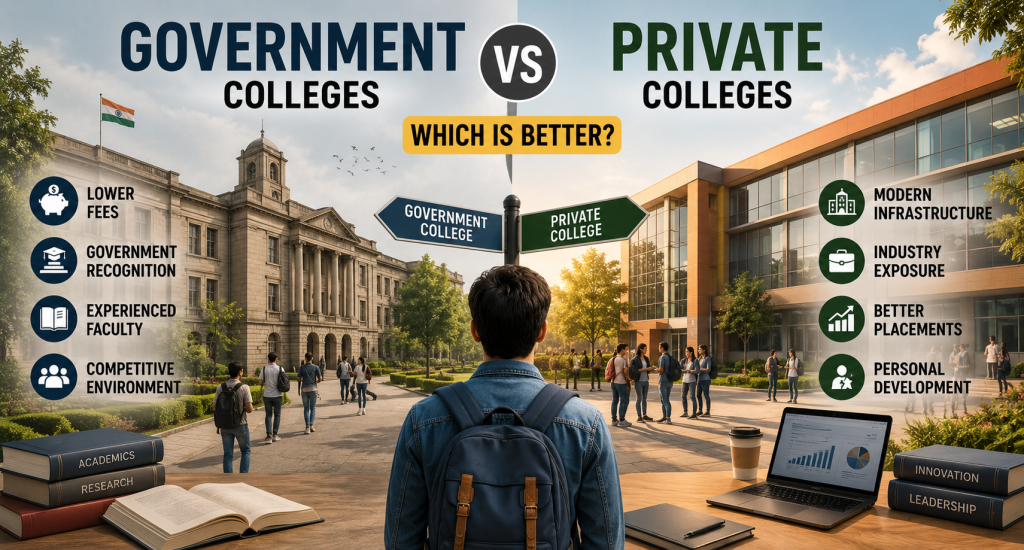
Both government and private colleges offer unique advantages, and neither is universally better than the other. Government colleges provide affordable education and strong academic traditions, while private colleges often excel in infrastructure, industry collaboration, modern teaching methods, and career-focused learning.
The best college is one that aligns with your academic interests, financial circumstances, career aspirations, and personal goals. Rather than focusing only on whether an institution is government or private, students should evaluate the overall quality of education, learning opportunities, and support available for their future success.
Making an informed decision today can lay the foundation for a rewarding academic journey and a successful professional career tomorrow.